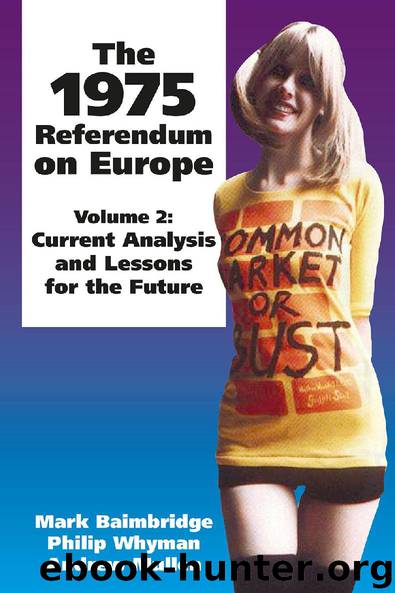
The 1975 Referendum on Europe - Volume 2 by Mark Baimbridge
Author:Mark Baimbridge
Language: eng
Format: epub
Tags: Europe, EU, European Union, referendum, constitution, economics, politics, diplomacy, democracy, eurosceptic, euroskeptic, government, self-government, Labour Party, Conservative Party, trade unions, sovereignty
ISBN: 9781845406325
Publisher: Andrews UK Limited 2016
Published: 2016-10-28T00:00:00+00:00
Schultz, 1987; Minford, 1990). Despite the evidence being rather mixed (Korpi, 1985 and 1996; Jackman et al, 1990:483; Barr, 1992; Rhodes, 1992:29), this neo-liberal argument has been at least partially adopted by leading European politicians, as demonstrated by British Prime Minister, Tony Blair, emphasising the need for all EU member economies to restructure their traditional approaches to social welfare and labour regulation. Indeed, in a recent speech [1], Blair pointedly rejected the ‘old social model’ in Europe, and argued that ‘our welfare systems and labour markets will require fundamental reform’. This is consistent with a recent statement made by the ECB’s senior economist, Otmar Issing, who blamed the poor performance of the Euro on ‘the adverse impact of minimum wage and employment protection legislation ’, which can only be overcome by a ‘comprehensive programme of structural reform’. [2]
In practice, this consists of creating what Cerny (1990) describes as a transition from welfare state to ‘competition state’, in which policies are determined by the perceived demands of survival in the global economy. Yet, this is in direct conflict with the ESM approach, as universal welfare provision is replaced by education, training and mobility measures designed to enhance productivity and increase employment levels. Moreover, it would re-commodify individuals, albeit provide them with the opportunity to develop more skills and therefore be better placed in the labour market. Consequently, it appears paradoxical that British trade union leaders are relying upon the completion of an ESM to provide them with a preferable system of social protection and employee participation in the work process, when EU governments are increasingly questioning the future of this very model. Whether due to concerns over the future ability to afford generous levels of welfare expenditure, or due to a desire to restructure social policy to aid international competition rather than provide a sanctuary from commodification, the ESM approach looks less viable as a future model for Euro-land than in previous circumstances.
The f inal elem ent o f a fully-fledged E SM, n am ely t he Europeanisation of industrial relations and wage bargaining, remains problematic. Whilst the EWC initiative does provide a potential basis for facilitating co-operation and the pooling of information between EU trade unions, this looks unlikely to lead onto a form of pattern bargaining, particularly since employer groups and big business are equally determined that this type of co-ordination of the market will not occur (Teague, 1991; Rhodes, 1992:45). It is, moreover, possible that the creation of a European labour market may be limited to certain key groups of workers, possessing specific technical and managerial skills, and for particular categories of highly mobile labour, notably managers, construction workers, labourers and young people (Walsh et al, 1995:85). This would further exacerbate income inequality and fracture national systems of wage bargaining (Marsden, 1992:593). In such circumstances, it is possible that workers adopt group egoist rather than class solidarity perspectives and unions may fragment along supranational company lines, with unions risking becoming ‘partners ... of regional capital trying to
Download
This site does not store any files on its server. We only index and link to content provided by other sites. Please contact the content providers to delete copyright contents if any and email us, we'll remove relevant links or contents immediately.
| Africa | Americas |
| Arctic & Antarctica | Asia |
| Australia & Oceania | Europe |
| Middle East | Russia |
| United States | World |
| Ancient Civilizations | Military |
| Historical Study & Educational Resources |
Room 212 by Kate Stewart(5187)
The Crown by Robert Lacey(4869)
Endurance: Shackleton's Incredible Voyage by Alfred Lansing(4848)
The Iron Duke by The Iron Duke(4409)
The Rape of Nanking by Iris Chang(4267)
Joan of Arc by Mary Gordon(4160)
Say Nothing by Patrick Radden Keefe(4049)
Killing England by Bill O'Reilly(4046)
I'll Give You the Sun by Jandy Nelson(3499)
Shadow of Night by Deborah Harkness(3412)
Hitler's Monsters by Eric Kurlander(3389)
Blood and Sand by Alex Von Tunzelmann(3244)
Mary, Queen of Scots, and the Murder of Lord Darnley by Alison Weir(3243)
Eleanor & Park by Rainbow Rowell(3240)
Darkest Hour by Anthony McCarten(3165)
Margaret Thatcher: The Autobiography by Thatcher Margaret(3114)
Book of Life by Deborah Harkness(2988)
Red Famine: Stalin's War on Ukraine by Anne Applebaum(2973)
The One Memory of Flora Banks by Emily Barr(2902)
